


Gift Cards in Portugal: Single- and Multi-Purpose Vouchers
When a Shopify gift card carries VAT in Portugal: on sale if single-purpose, or when spent if multi-purpose. With an example and what the invoice shows.
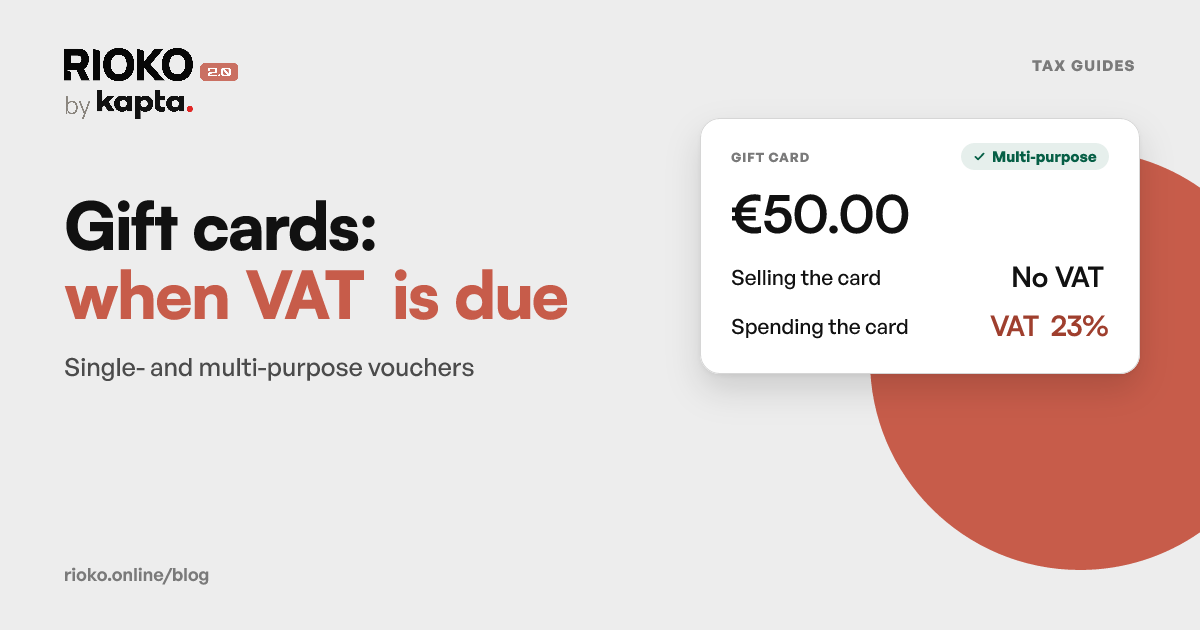
Shopify sells gift cards like any other product, and accepts them at checkout as a way to pay. For invoicing, a gift card raises two questions Shopify does not answer on its own: does selling the card carry VAT? And when the card is spent, does the invoice carry VAT on the part it paid?
The answer is in the Portuguese VAT Code (CIVA), which since 2019 treats gift cards as vouchers and has two rules for them: one for single-purpose vouchers, another for multi-purpose ones. The total VAT ends up the same. What changes is when it is due and which document goes out at each moment.
What counts as a voucher
Under the VAT Code, a voucher is an instrument that gives the holder the right to receive goods or services in exchange for it, whatever its name and whether on paper or electronic (article 1(2)(l)). A Shopify gift card fits here.
Discount vouchers and mere means of payment are left out. A discount code lowers the order price, and the invoice shows the total the customer paid.
These rules come from Law 71/2018, which transposed Directive (EU) 2016/1065, and apply to vouchers issued from 1 January 2019.
Single-purpose or multi-purpose
The difference comes down to one question: when the card is sold, is everything that defines the VAT already known?
| Single-purpose | Multi-purpose | |
|---|---|---|
| Definition | At sale, the place of supply and the VAT rate are known (point m)) | At sale, not all of those are known (point n)) |
| When VAT is due | Each time the card is sold (article 7(13)) | When the card is spent (article 7(14)) |
| Selling the card | Invoice, with VAT | No VAT and no invoice |
| Spending the card | Invoice only for what was paid by other means | Invoice for the total, with VAT |
| Typical example | Shop that only sells products at one rate, only in Portugal | Shop with different rates, or that sells to other countries |
In an online shop, multi-purpose is the more common case. A catalogue with one product at 6% and another at 23%, or a shop selling to other EU countries with OSS, is enough for the rate to be known only when the card is spent. The shop decides, with its accountant, by looking at what the card can pay for.
One example, under both rules
A customer buys a €50 gift card. Later, they spend it on an €80 order and pay the other €30 by bank card. The products carry 23% VAT.
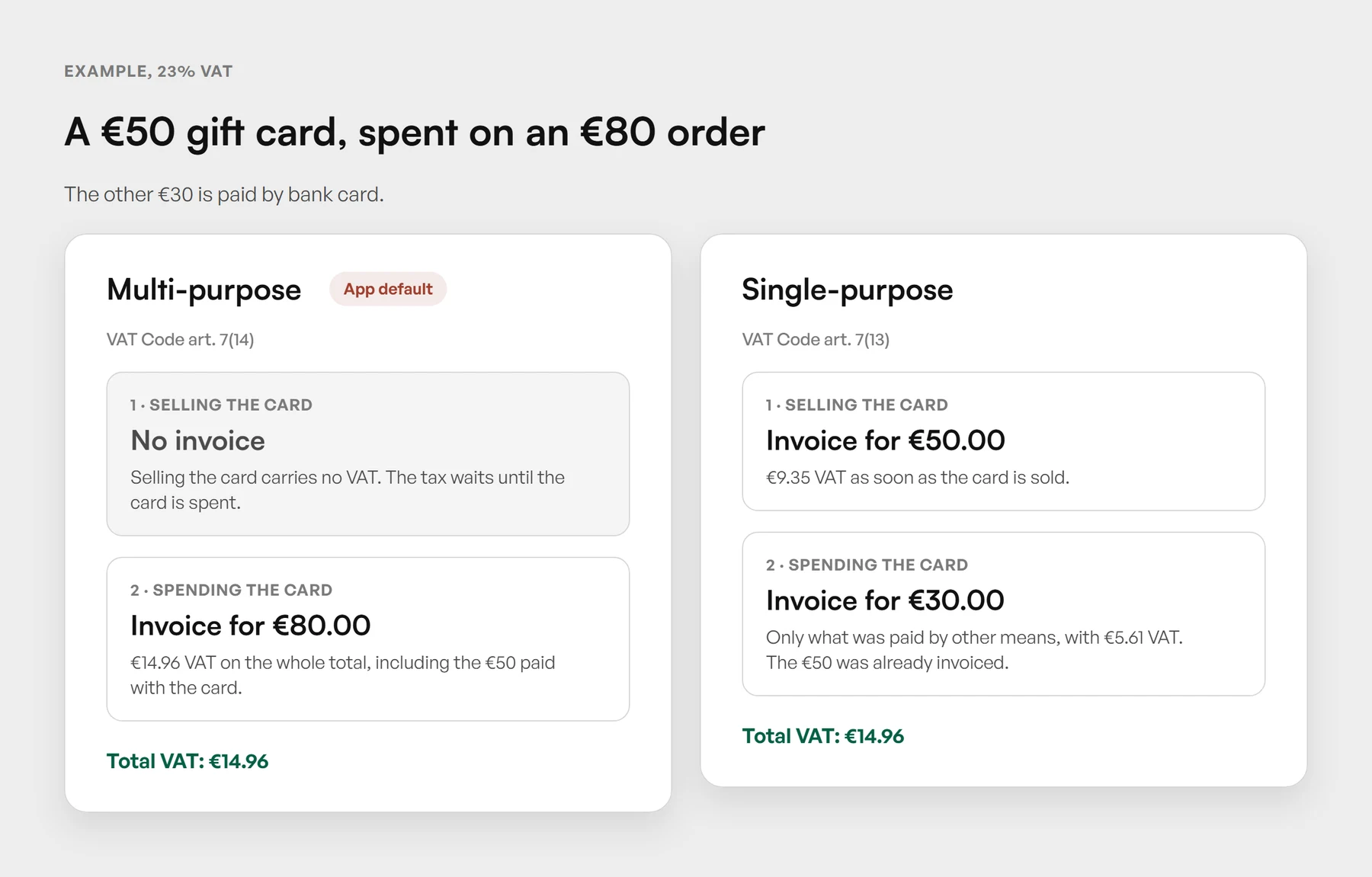 The total VAT is the same under both rules. What changes is when it is due and the document at each moment.
Multi-purpose. Selling the card carries no VAT and no invoice: no goods have been supplied yet. When the card is spent, the invoice is for €80, with €14.96 VAT. The taxable amount is the consideration paid, less the tax (article 16(13)), so the €50 paid with the card is part of the base.
Single-purpose. Selling the card gets a €50 invoice, with €9.35 VAT. When the card is spent, handing over the products for it is not a new supply (article 30b of Directive 2016/1065), and only the €30 paid by other means is invoiced, with €5.61 VAT.
What Shopify does, and what is left to decide
Shopify handles a gift card in two ways:
- At sale, the card is a line on the order, and Shopify calculates no tax on it.
- When spent, the card is a payment method, not a discount: the order total stays the same, and the amount paid with the card shows in the order's transactions (Shopify help).
If invoicing copies the order as it arrives, it goes wrong both ways. With multi-purpose, it invoices the card sale as if it were a product. With single-purpose, it invoices the card sale without VAT and, when the card is spent, invoices again the part the card already paid.
How the InvoiceXpress by Kapta app invoices gift cards
The InvoiceXpress by Kapta app, made by the Rioko team, invoices Shopify orders in InvoiceXpress. Gift cards follow the option the shop chooses in Settings › Gift cards.
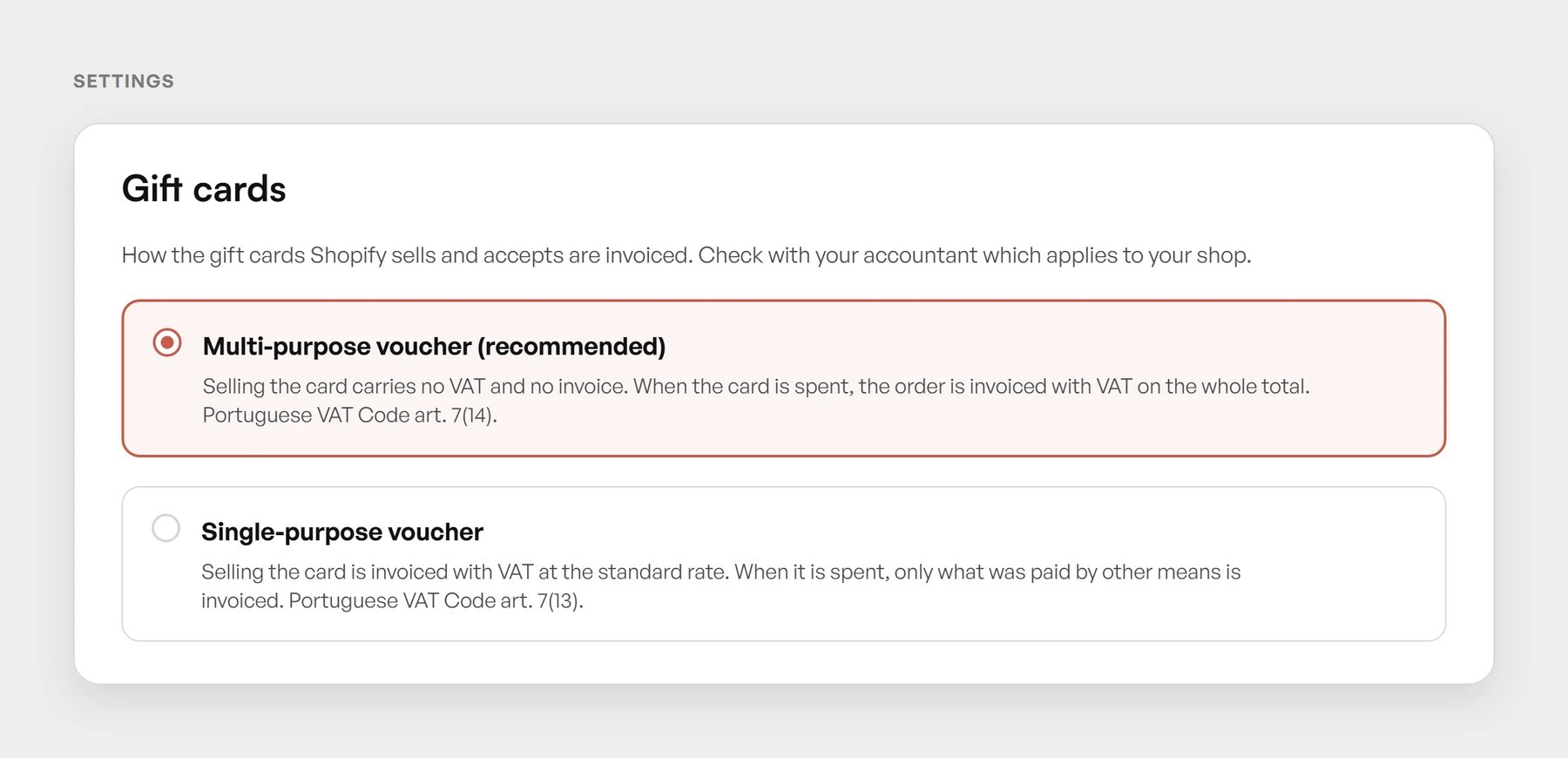 The choice is made once, in the app Settings. Multi-purpose is selected by default.
Multi-purpose voucher (recommended, the default):
- An order with only gift cards gets no document.
- On an order with a card and products, the invoice carries only the products, with a note about the card left out.
- When the card is spent, the order is invoiced for the total, with VAT.
Single-purpose voucher:
- Selling the card is invoiced with VAT at the standard rate of the shop's region.
- When the card is spent, the invoice carries only what was paid by other means. Each line keeps its item and rate, with the price lowered in the same proportion, so that VAT falls only on the money not yet invoiced.
- An order paid entirely with the card gets no document.
If Shopify does not let the app read an order's gift cards, the app does not invoice it blind: it tries again and, if it still cannot, the order shows as not invoiced. Invoicing without knowing what the card paid would charge the VAT twice, or not at all.
Before you sell gift cards
- Decide with your accountant whether your cards are single-purpose or multi-purpose, looking at the rates in your catalogue and the countries you sell to.
- Choose the option in the app before the first sale. A card sold under one rule and spent under the other has its VAT counted twice or not at all.
- Check how long the cards are valid. A multi-purpose voucher that expires unused has a rule of its own (article 7(15)(b)), and expiry never goes through an order.
- Check the first invoices on orders with cards: the card sale, a mixed order and a card being spent.
Gift cards multiply during campaigns. The Black Friday list puts them alongside the other invoicing points to check, and the Shopify guide covers the rest of each order's path.
See the InvoiceXpress by Kapta app documentation → · How Rioko invoices Shopify
Sources
- VAT Code, article 1(2)(l) to (n): voucher, single-purpose and multi-purpose voucher
- VAT Code, article 7(13) to (15): when VAT is due on vouchers
- VAT Code, article 16(13): taxable amount for multi-purpose vouchers
- Directive (EU) 2016/1065, on the treatment of vouchers
- Shopify: using gift cards at checkout
Frequently asked questions
What is a multi-purpose voucher?
A voucher where, when it is sold, not everything needed to work out the VAT is known: for example, because it can be spent on products at different rates or by customers in other countries. VAT is only due when the voucher is spent (VAT Code, article 7(14)).
What is a single-purpose voucher?
A voucher where everything needed to work out the VAT is known when it is sold: the place of supply and the rate. VAT is due each time the voucher is sold (VAT Code, article 7(13)).
Is a Shopify gift card single-purpose or multi-purpose?
It depends on what the shop sells and to whom. If the card can pay for products at different rates, or be spent on orders to other countries, the rate is not known at sale and the voucher is multi-purpose. Check with your accountant; in the InvoiceXpress by Kapta app, multi-purpose is the default.
Does selling a gift card need an invoice?
With a single-purpose voucher, yes: selling the voucher is taxed, with VAT. With a multi-purpose voucher, the sale is not a taxable supply, so it carries no VAT and the app issues no invoice for it. The invoice comes when the card is spent.
When the card is spent, does the invoice carry VAT on the whole order?
With a multi-purpose voucher, yes: the tax is due at that moment, including the part paid with the card. With a single-purpose voucher, no: that part already carried VAT when the card was sold, and only what was paid by other means is invoiced.
What if the customer buys a card and products in the same order?
With multi-purpose, the invoice carries only the products, and the card is left out of the document. With single-purpose, the card goes on the document as one more line, with VAT at the standard rate.
What if the card is never spent?
A multi-purpose voucher that expires unused, with no refund, has a rule of its own in the VAT Code (article 7(15)(b)). Expiry is not an order, so the app issues nothing at that moment: handle it with your accountant.
Is a discount code a voucher?
No. The VAT Code leaves out discount vouchers and mere means of payment that give no right to receive goods or services (article 1(2)(l)). A discount code lowers the price, and the invoice shows the total the customer paid.
Where do I choose the voucher type in the app?
In Settings, in the Gift cards field, between Multi-purpose voucher (recommended) and Single-purpose voucher. See the app documentation.
Can I change the option after selling cards?
You can, but documents already issued stay as they are, and a card sold under one rule and spent under the other has its VAT counted twice or not at all. Choose with your accountant before selling cards.
Still have questions
Write the question. It reaches a person, not a form.